





For students interested in science, engineering, technology, aviation, business, and other career-focused fields, Florida Institute of Technology stands out for its strong connection to innovation and the U.S. space industry. Located in Melbourne, Florida, the university has built its identity around hands-on learning, research, and preparing students for technical careers. Its history, academic offerings, location, and professional connections make it an interesting choice for students looking beyond a traditional college experience.
What Is Florida Institute of Technology?
Florida Institute of Technology, commonly known as Florida Tech, is a private, not-for-profit research university in Melbourne, Florida. The institution was founded in 1958 as Brevard Engineering College by physicist Jerome P. Keuper, who had worked around Cape Canaveral during the early years of the American space program. The university adopted its current name in 1966 as its academic mission expanded.
From the beginning, the university was closely connected with the technical demands of the Space Coast. Its original purpose was to provide educational opportunities for scientists, engineers, and technicians working in the emerging space industry. That background continues to influence the university’s academic culture today.
Rather than focusing only on classroom theory, Florida Tech emphasizes practical experience and research. Students can encounter laboratory work, projects, internships, field experiences, and other opportunities designed to connect academic knowledge with real-world problems.
A University With Space Coast Roots
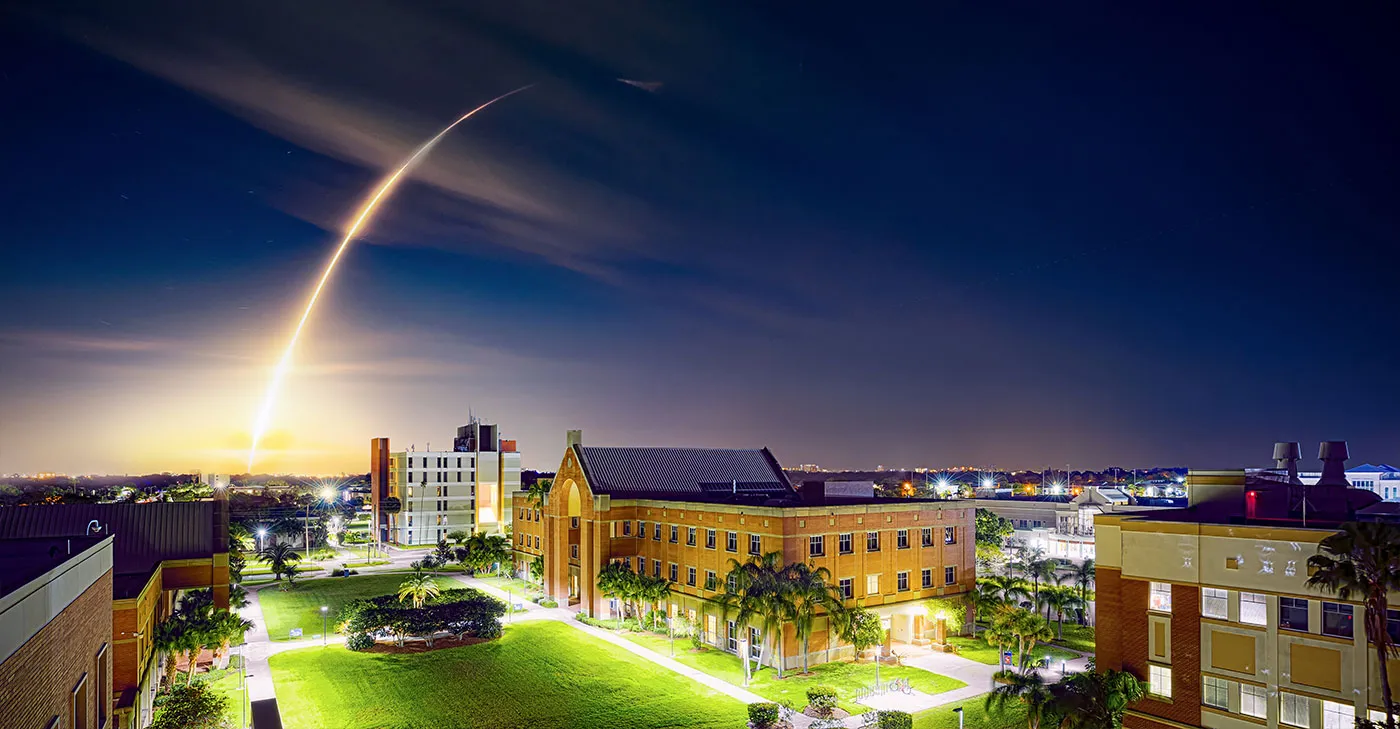
One of the most distinctive features of Florida Institute of Technology is its location. Melbourne sits along Florida’s Space Coast, within a region associated with aerospace research, aviation, defense, technology, and space exploration.
The university describes its proximity to organizations and employers such as NASA’s Kennedy Space Center, SpaceX, Northrop Grumman, Embraer, and other major institutions as an important advantage for students seeking internships and professional experience.
This setting can be particularly attractive for students who want careers connected to aerospace engineering, aviation, space systems, computer science, robotics, or other technical disciplines. The surrounding environment effectively provides another dimension to the educational experience.
The area also offers a lifestyle that combines a university community with beaches, outdoor recreation, and access to larger destinations such as Orlando. For students who prefer a smaller coastal community instead of a huge metropolitan campus, Melbourne can offer a different type of college experience.
Academic Programs and Learning
Florida Tech has a broad academic portfolio, although science, technology, engineering, and mathematics remain central to its identity. The university offers programs across engineering and science, aeronautics, business, psychology and liberal arts, communication, and other disciplines.
Engineering is especially prominent. Programs include aerospace, biomedical, chemical, civil, computer, electrical, mechanical, ocean, and software engineering. Computer science is also accredited through ABET’s Computing Accreditation Commission.
For students considering careers in aviation, the College of Aeronautics provides programs in areas including aeronautical science and aviation management. Some programs are specifically designed to incorporate flight education, giving students an opportunity to connect academic study with aviation practice.
The university also offers programs outside traditional STEM disciplines. Business, psychology, communication, humanities, and related subjects allow students with different interests to pursue degrees within the same institution.
Hands-On Experience Matters
A major attraction of Florida Tech is its emphasis on learning by doing. The university presents its educational model as research-driven and hands-on, with students encouraged to engage with their chosen discipline from an early stage.
For an engineering student, that might mean laboratory experiments, design projects, or research. For an aviation student, practical flight-related training can become part of the educational journey. For marine science students, the nearby Atlantic Ocean and Indian River Lagoon provide an unusually useful natural environment.
This approach can be valuable because employers often look beyond grades when evaluating graduates. The ability to work on projects, solve problems, communicate with colleagues, and apply technical knowledge can make a meaningful difference when entering the workforce.
Research and Innovation
Research is another important part of the university’s identity. Florida Tech’s history is closely connected with aerospace and engineering, but its research activity extends into areas such as environmental science, marine studies, computing, biomedical science, and other fields.
The Indian River Lagoon Research Institute is one example of the university’s connection to its surrounding environment. Faculty have studied the lagoon for decades, while the institute, established in 2013, brings together science and engineering expertise to address the health and sustainability of the estuary.
This type of research creates opportunities for students to see how academic work can address problems outside the university. It also reflects a broader principle: technological education is most useful when it can be applied to genuine challenges facing society.
Accreditation and Academic Quality
When evaluating a university, accreditation is one of the practical details students should investigate carefully. Florida Institute of Technology is institutionally accredited by the Southern Association of Colleges and Schools Commission on Colleges, commonly known as SACSCOC, to award associate, bachelor’s, master’s, educational specialist, and doctoral degrees. Its accreditation was reaffirmed in 2025, with the next reaffirmation scheduled for 2035.
Several individual programs also hold specialized accreditation. For example, a range of engineering programs are accredited by ABET, while the computer science bachelor’s program has computing accreditation through ABET. Aviation programs also have specialized accreditation through the Aviation Accreditation Board International.
These distinctions are important because institutional accreditation and program-level accreditation serve different purposes. Students should always check the accreditation status of the specific program they intend to study rather than assuming that every degree carries identical specialized accreditation.
Student Life and Campus Experience
Although academics are a major part of Florida Tech’s identity, university life extends beyond classrooms and laboratories. Students have access to clubs and organizations, athletics and esports, residence life, fitness and recreation, campus dining, arts and culture, and other activities.
The university also has an international dimension. Florida Tech reports that approximately one-third of its on-campus undergraduate student body is international, creating an environment where students can interact with peers from different countries and backgrounds.
The relatively focused campus environment can appeal to students who prefer closer interaction with professors and classmates. At the same time, the Melbourne location provides access to outdoor activities, beaches, and the wider Space Coast.
Faculty and Career Preparation
Florida Tech reports having 424 faculty members, with about 74% of full-time teaching faculty holding a Ph.D. or another appropriate terminal degree.
Faculty expertise is particularly important at a university where research and technical education play such prominent roles. Students interested in advanced study can benefit from working around professors involved in research, while undergraduate students can gain exposure to professional approaches within their fields.
Career preparation is another significant consideration. The university’s location near aerospace, defense, aviation, technology, and scientific organizations gives students access to a region where technical skills are in demand. Internships and cooperative experiences can help students develop professional connections before graduation.
Who Should Consider Florida Tech?
Florida Institute of Technology may be particularly appealing to students who already have a strong interest in technical or career-oriented subjects. Someone fascinated by aerospace, space exploration, engineering, computer science, aviation, marine science, or applied research may find the university’s environment especially relevant.
It can also suit students who want a private university experience without giving up access to a major research and technology ecosystem. However, choosing a university should never depend on reputation alone. Prospective students should compare the specific degree curriculum, total cost, financial aid, housing, campus environment, internship opportunities, and career outcomes with their own priorities.
A university can be excellent overall while still not being the right fit for every student. The strongest choice is the one that matches a student’s academic goals, budget, preferred learning environment, and long-term career plans.
Frequently Asked Questions
Where is Florida Institute of Technology located?
Florida Tech is located in Melbourne, Florida, on the state’s Space Coast. Its position places students near aerospace, aviation, technology, and scientific organizations while also providing access to beaches and outdoor activities.
Is Florida Institute of Technology accredited?
Yes. The university is institutionally accredited by SACSCOC. Its accreditation was reaffirmed in 2025, and the next reaffirmation is scheduled for 2035. Several individual programs also hold specialized accreditations.
What is Florida Tech known for?
Florida Tech is particularly known for engineering, aerospace, aviation, science, computing, and its historical connection with the U.S. space program. Its broader academic offerings also include business, psychology, communication, and liberal arts.
Does Florida Tech offer hands-on learning?
Yes. Hands-on education is a central part of the university’s approach. Students can participate in laboratories, research, projects, internships, field experiences, and discipline-specific practical training.
Is Florida Tech a good choice for aerospace students?
Its location and academic history make it a particularly relevant option for students interested in aerospace. Being situated on Florida’s Space Coast provides proximity to major aerospace and space organizations, while the university offers aerospace-related academic programs and research opportunities.
Final Thoughts
Florida Institute of Technology has developed from a small technical school created during the early Space Race into a comprehensive research university with a strong reputation for science, engineering, technology, and hands-on education. Its Melbourne location gives students an unusual connection to the aerospace and technology industries, while its academic portfolio provides options beyond STEM.
For prospective students, the university’s strongest appeal may be the combination of practical learning, research opportunities, specialized programs, and access to the Space Coast professional community. At the same time, applicants should evaluate their intended program individually, paying attention to accreditation, cost, curriculum, student support, and career opportunities.
Ultimately, Florida Institute of Technology offers an environment built around curiosity, technical problem-solving, and practical experience. For students who want an education closely connected to innovation and the industries shaping tomorrow, it is an institution worth taking a serious look at.