




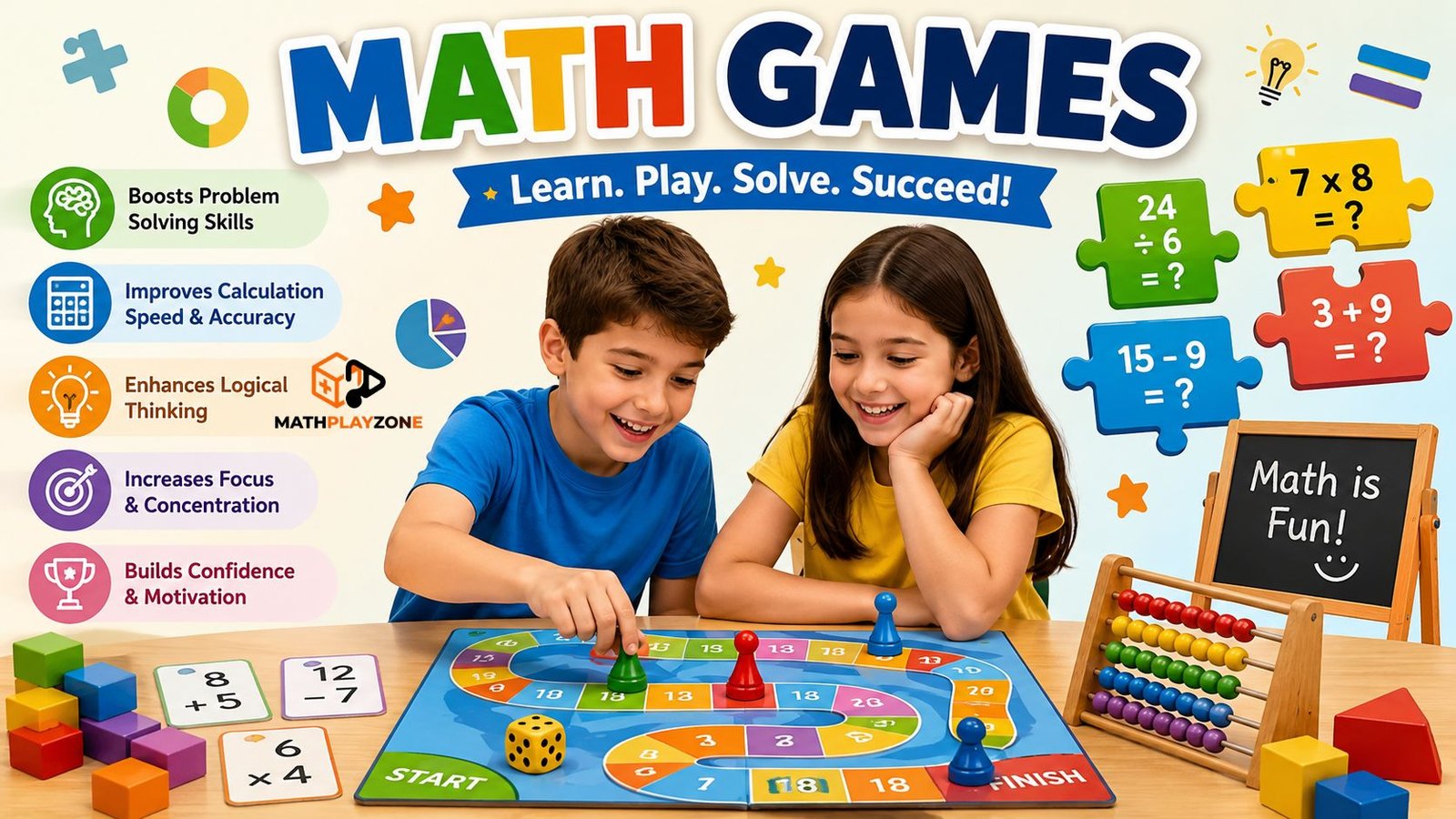
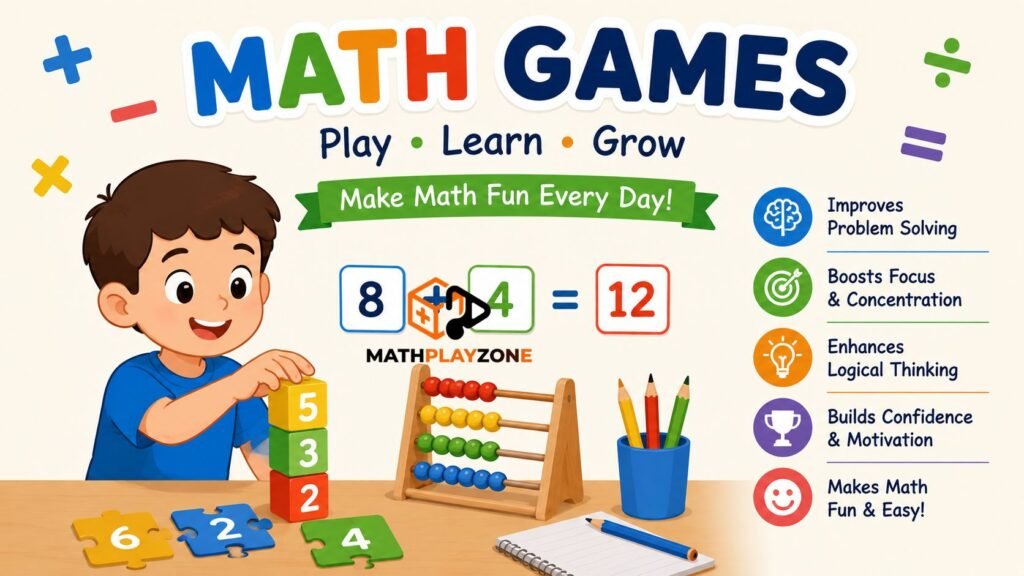
Math games have become one of the most effective ways to make mathematics enjoyable for learners of all ages. Instead of relying on traditional worksheets and repetitive exercises, games transform numbers, equations, and problem-solving into exciting challenges. Whether played in classrooms, at home, or online, these games help improve mathematical skills while keeping players engaged and motivated.
Modern education has recognized the importance of interactive learning. Math games encourage critical thinking, logical reasoning, creativity, and confidence. They remove the fear often associated with mathematics and replace it with curiosity and excitement. As a result, students are more willing to practice and develop their numerical abilities without feeling pressured.
Quick Bio
| Information | Details |
|---|---|
| Topic | Math Games |
| Category | Educational Games |
| Purpose | Improve mathematical and problem-solving skills |
| Suitable For | Kids, Students, Teachers, and Adults |
| Learning Style | Interactive and Game-Based Learning |
| Benefits | Fun, Engaging, and Skill-Building |
| Feature | Description |
|---|---|
| Main Skills | Addition, Subtraction, Multiplication, Division, Geometry, Algebra |
| Game Types | Online Games, Board Games, Card Games, Puzzles, Mobile Apps |
| Difficulty Levels | Beginner, Intermediate, Advanced |
| Devices | Computer, Tablet, Smartphone, and Offline Activities |
| Key Advantages | Boosts Logic, Memory, Focus, Confidence, and Critical Thinking |
| Best Use | Home Learning, Schools, Homeschooling, and Brain Training |
What Are Math Games?
Math games are educational activities designed to teach or reinforce mathematical concepts through play. These games combine entertainment with learning, allowing players to solve problems, complete puzzles, or compete in challenges involving numbers and calculations.
They can be played individually or with groups, making them suitable for classrooms, families, and friends. Some math games use cards, dice, boards, or physical objects, while others are digital and available through computers, tablets, or smartphones.
The primary goal is to strengthen mathematical understanding while making learning enjoyable and interactive.
Benefits of Playing Math Games
Math games provide numerous educational and cognitive benefits that extend beyond the classroom.
Improves Problem-Solving Skills
Every math game requires players to think carefully before making decisions. Whether solving equations, identifying patterns, or completing puzzles, players learn to analyze situations and choose the best solutions.
Builds Strong Number Sense
Regular exposure to numbers through games helps players become comfortable with counting, estimating, comparing, and calculating. This strong number sense forms the foundation for advanced mathematics.
Increases Confidence
Many learners struggle with mathematics because they fear making mistakes. Games create a low-pressure environment where mistakes become opportunities for learning rather than reasons for embarrassment.
Enhances Memory
Remembering formulas, multiplication tables, fractions, and mathematical rules becomes easier when they are practiced repeatedly during gameplay. Interactive learning helps information stay in long-term memory.
Encourages Critical Thinking
Many math games require strategic planning rather than simple calculations. Players must evaluate different possibilities before making decisions, strengthening logical reasoning skills.
Develops Concentration
Math games require attention, patience, and focus. Regular practice helps improve concentration, which benefits both academic performance and everyday activities.
Makes Learning Enjoyable
Perhaps the biggest advantage is that math becomes fun instead of stressful. Children especially remain motivated when learning feels like play rather than work.
Types of Math Games
There are many different categories of math games, each focusing on specific mathematical skills.
Addition and Subtraction Games
These games introduce basic arithmetic through colorful activities, puzzles, matching challenges, and timed quizzes. They are ideal for young learners beginning their mathematical journey.
Multiplication Games
Multiplication games help students memorize times tables while developing speed and accuracy. Many use races, card games, or interactive challenges that reward quick thinking.
Division Games
Division games simplify one of the more difficult arithmetic operations by breaking concepts into enjoyable activities that encourage repeated practice.
Fraction Games
Fractions become much easier to understand through visual puzzles, matching games, cooking simulations, and interactive exercises.
Geometry Games
Geometry games teach shapes, angles, symmetry, measurement, and spatial awareness. These games often involve drawing, building, or recognizing patterns.
Algebra Games
Older students benefit from algebra games that involve solving equations, identifying variables, and discovering mathematical relationships through logical puzzles.
Logic and Puzzle Games
Sudoku, magic squares, number puzzles, and pattern recognition games develop reasoning skills while strengthening mathematical thinking.
Why Children Love Math Games
Children naturally enjoy games because they provide rewards, excitement, and opportunities to explore. When mathematics is combined with game elements such as points, levels, achievements, and friendly competition, children become more willing to participate.
Unlike traditional lessons, games encourage experimentation. Children are not afraid of making mistakes because they can immediately try again. This positive learning environment increases motivation and reduces anxiety.
Bright graphics, engaging sounds, interactive animations, and achievable goals also help maintain interest for longer periods.
Math Games for Different Age Groups
Preschool Children
Young learners benefit from games involving counting objects, recognizing numbers, identifying shapes, sorting colors, and simple addition.
Elementary Students
Children in elementary school enjoy multiplication races, number puzzles, money-counting games, measurement activities, and basic geometry challenges.
Middle School Students
At this stage, games involving fractions, decimals, percentages, algebra, probability, and logic puzzles help reinforce classroom learning.
High School Students
Older learners can practice advanced algebra, geometry, trigonometry, statistics, and mathematical reasoning through challenging strategy games and simulations.
Adults
Math games are not only for children. Adults enjoy brain-training puzzles, Sudoku, logic challenges, financial calculation games, and strategy-based mathematical activities that help keep the mind active.
Math Games in the Classroom
Teachers increasingly use math games as part of daily lessons because they improve student participation and understanding.
Classroom math games encourage teamwork, communication, and healthy competition. Students often learn from one another while solving problems together.
Games also provide teachers with opportunities to observe student progress in a relaxed environment. Instead of relying only on tests, educators can identify strengths and areas needing improvement during gameplay.
Many schools now combine traditional instruction with interactive learning to create balanced educational experiences.
Digital Math Games
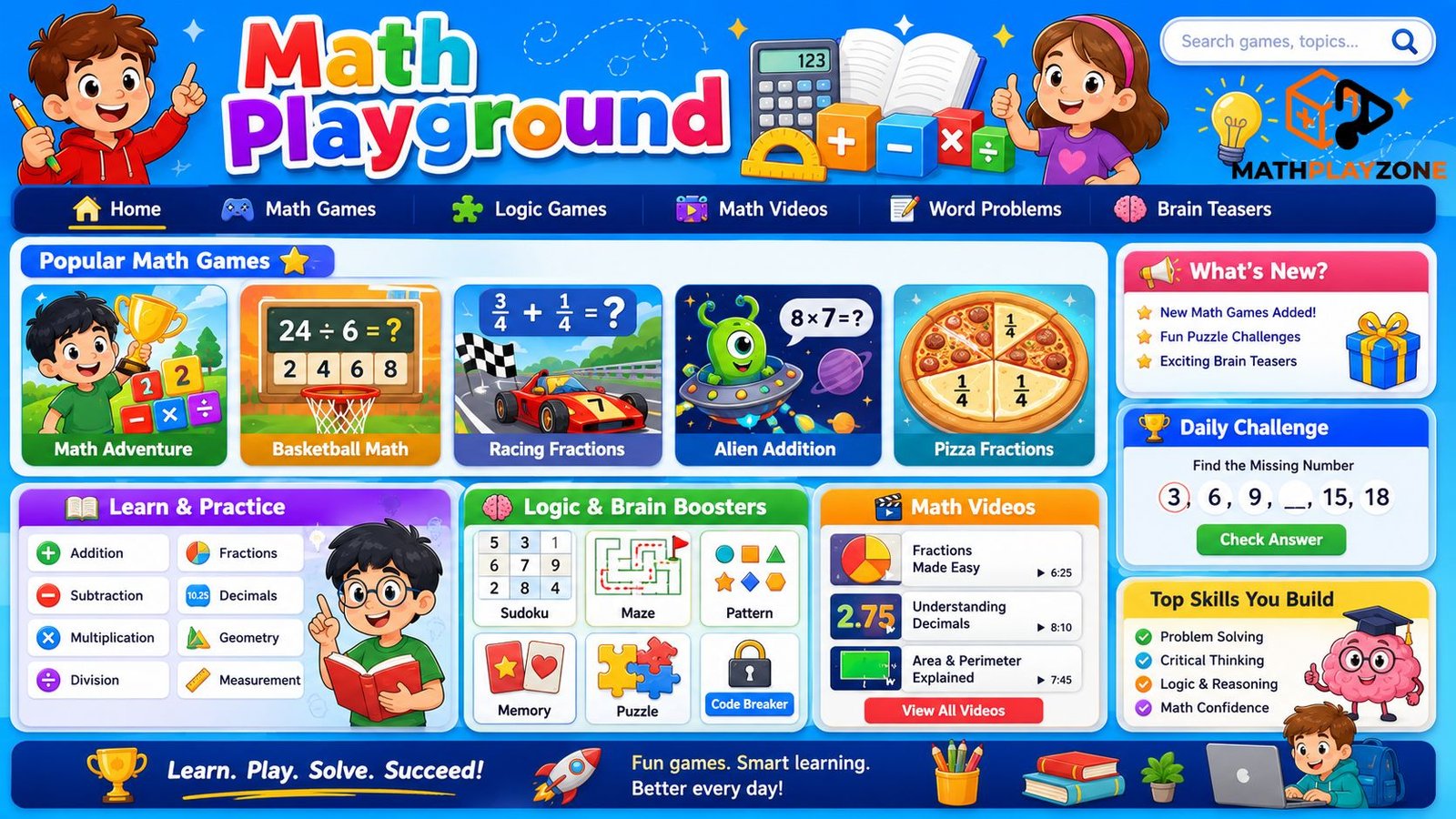
Technology has expanded access to educational games like never before. Digital math games offer instant feedback, adaptive difficulty levels, colorful graphics, and personalized learning experiences.
Students can practice independently at home or in school using computers, tablets, or smartphones. Many digital games automatically adjust the difficulty based on performance, ensuring learners remain challenged without becoming overwhelmed.
Progress tracking also helps parents and teachers monitor improvement over time.
Offline Math Games
Not every educational activity requires technology. Traditional math games remain highly effective and encourage face-to-face interaction.
Popular offline activities include:
- Number bingo
- Card math challenges
- Dice games
- Domino calculations
- Math scavenger hunts
- Board games
- Puzzle races
- Flashcard competitions
- Pattern-building activities
These games are inexpensive, easy to organize, and suitable for classrooms or family game nights.
How Parents Can Use Math Games at Home
Parents play an important role in developing positive attitudes toward mathematics.
Simple daily activities can become educational games without requiring expensive materials. Cooking teaches measurements and fractions. Grocery shopping helps children calculate prices and discounts. Board games strengthen counting skills, while puzzles improve logical thinking.
Setting aside even fifteen to twenty minutes each day for math games can significantly improve a child’s confidence and mathematical ability over time.
Positive encouragement and celebrating progress make learning even more enjoyable.
Tips for Choosing the Best Math Games
Not every math game offers the same educational value. Consider these factors when selecting one:
- Choose games appropriate for the learner’s age and skill level.
- Look for activities that encourage thinking instead of memorization alone.
- Select games with clear learning objectives.
- Ensure gameplay remains fun without becoming overly difficult.
- Include a variety of mathematical concepts to prevent boredom.
- Balance digital games with hands-on activities.
- Encourage cooperative as well as competitive play.
The best math games create meaningful learning experiences while maintaining excitement and curiosity.
Future of Math Games
Educational technology continues to evolve rapidly. Artificial intelligence, virtual reality, and augmented reality are creating highly personalized learning experiences that adapt to each student’s strengths and weaknesses.
Future math games may include immersive 3D environments, intelligent tutoring systems, voice interaction, and collaborative online challenges connecting learners worldwide.
Gamification will continue to play a major role in education by making mathematics more engaging, accessible, and effective for students of every age.
Math games are educational activities that combine fun and learning to help players improve their mathematical skills through puzzles, challenges, and interactive gameplay.
Math games make learning enjoyable while improving problem-solving, logical thinking, calculation speed, and overall confidence in mathematics.
Math games are suitable for everyone, including preschool children, students, teachers, parents, and adults who want to sharpen their math skills.
Conclusion
Math games are far more than simple entertainment. They are powerful educational tools that improve problem-solving skills, logical thinking, memory, concentration, and mathematical confidence. By transforming learning into an enjoyable experience, they help learners develop a positive relationship with mathematics that can last a lifetime.
Whether played online, offline, in classrooms, or at home, math games make education interactive, engaging, and rewarding. They encourage curiosity, creativity, and persistence while building essential mathematical skills needed for academic success and everyday life. As educational methods continue to evolve, math games will remain an important part of modern learning, helping students discover that mathematics can be both exciting and enjoyable.